
Backing the stewards of cultural and biological diversity/

History

The Founders and History of The Christensen Fund

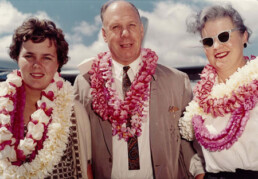
Allen D. and Carmen M. Christensen founded The Christensen Fund as a private foundation in California in 1957. Allen, who was a civil and mining engineer, served as President of the Utah Mining and Construction Company for many years, operating primarily in the Western United States and Pacific Rim until its merger with General Electric in 1971.  He was an enthusiastic and eclectic traveler and art collector with wide intellectual interests.  Carmen had a strong interest in education both as a public school teacher and instructor of studio arts, and was herself an artist. Mr. and Mrs. Christensen’s international concerns, their valuing of creativity, and deep interest in music, the arts, education and later the environment, have all strongly influenced the Fund’s direction. Two of their children, Karen Christensen and Diane Christensen, remain involved with the Fund and have steered it to its current configuration.  Having served as its Executive Director from 1989 to 2002, Diane Christensen was then Board Chair until 2010 and remains our President.

Beginning in the early 1970s, The Christensen Fund added to its various mostly San Francisco Bay Area-based charitable and educational activities the acquisition of fine arts and ethnographic artifacts. Its first art collection was a group of Pomo Indian baskets that are now at Harvard University’s Peabody Museum. From 1972 to 1999 the Fund was a private operating foundation, its operations being the collection and loan of as many as 35,000 pieces of what it then called “Non-Western Art” to major museums for their study and exhibition in Australia, Europe and the United States.  These activities contributed to the increasing appreciation in the West of the diversity of what has constituted artistic expression.

By 1981, the Fund’s focus had expanded to include support for research in natural history through its support of the Christensen Research Institution (CRI) in Papua New Guinea, which was to play a leading role in documenting tropical biodiversity. The Fund also supported the partners and organizations associated with CRI, including the California Academy of Sciences, the University of Oxford, Stanford University and the Australian Government’s Commonwealth Scientific and Industrial Research Organisation (CSIRO). Upon CRI’s closure in 1996 the Fund began grant-making to conservation organizations involved in conservation related field research. Principal among those was the Wildlife Conservation Society (WCS) (formerly known as the New York Zoological Society), and among other things grants both to WCS and to the Missouri Botanic Garden and its associated institutions have funded the training of over a hundred conservation biologists, particularly from Latin America, Papua New Guinea and Africa.

During the 1980s and 1990s years the Fund continued its support of art museums in raising understanding of the richness of the world’s artistic and cultural traditions.  It has particularly been associated with Indonesian and Japanese textiles, classical Chinese art, Ethiopian Coptic crosses, and indigenous traditions of Papua New Guinea and Australia.

The Fund has also long made larger grants to public and private schools and other organizations offering educational programs for children. From 2000-2002, the Fund ran a small grants program supporting studio art and conservation science education programs in both public and private K-12 schools.  This concern for young people and education endures in our programs.

Following the passing of Allen Christensen in 1989, the Fund consolidated its mission, with education providing the linkage between the arts and conservation programs.  The Fund also decided that the time was ripe to donate its art collections to the leading museums at which these were on loan (see Art Collection), or repatriate them to appropriate local institutions in those cases where it was discovered that the items should not have been acquired (in particular a collection of sacred Australian Aboriginal objects), or had been issued with false certificates of provenance (as was the case with a large pre-
Columbian collection from Mexico).  The making of these donations and repatriations accelerated in the late 1990s and was completed in 2002. By this stage, the Fund had ceased to be an operating foundation and became a private foundation, solely dedicated to its grant-making and associated activities.

In the early 2000s the Fund began an ordered transition away from being a family foundation.  Having created a new Board of majority non-familymembers it engaged in 2002 its first non-family Executive Director, Dr. Kenneth Wilson, and developed staffing and operational systems to work in its five priority regions around the world.  In 2003 the Fund integrated its concerns with rich artistic traditions with its work around biodiversity to become the first private foundation to explicitly develop a “biocultural diversity” focus for its work.

The Fund’s initial endowment dates back to 1986, and when Carmen Christensen passed in 2010 she left a further bequest to the Fund.